Retroperitoneal Hematoma
David Ray Velez, MD
Table of Contents
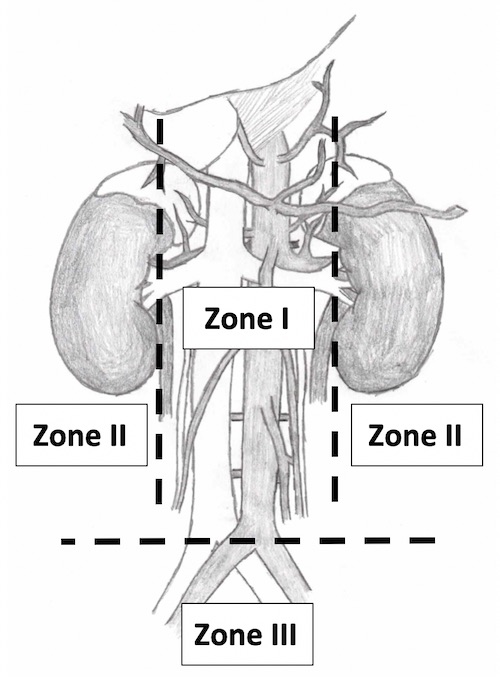
Zones of the Retroperitoneum
Zone I: Central – Extends from the Diaphragm to the Aorta/IVC Bifurcations, Extending to the Kidneys Bilaterally
- Supramesocolic: Above the Transverse Mesocolon
- Inframesocolic: Below the Transverse Mesocolon
- Associated with Pancreaticoduodenal and Major Vascular Injury
Zone II: Lateral – Extending from the Kidneys to the Paracolic Gutters
- Associated with Kidney and Renal Vascular Injury
Zone III: Pelvis
- Associated with Iliac Vascular Injury

Retroperitoneal Zones
Indications for Exploration
Zone I (Central)
- Mandatory Exploration for All Zone I Hematomas Regardless of Mechanism – High Risk for Major Vascular Injury
Zone II/III (Lateral/Pelvis)
- Penetrating: Mandatory Exploration*
- Blunt: Explore Only if Expanding, Pulsatile, or with Active Hemorrhage
- *Some Prefer Selective Exploration for Penetrating Zone II Injuries – Exploration Increases the Chances of Nephrectomy
- May Instead Consider Preperitoneal Pelvic Packing (PPP) with Postoperative Angioembolization for Select Zone III Hematomas
Retroperitoneal Exposure
Keep Retroperitoneal Exploration Targeted and Limited
Clinical Suspicion Based on Missile Trajectory or Presence of Hematoma
Maneuvers
- Left-Sided Medial Visceral Rotation (Mattox Maneuver)
- Right-Sided Medial Visceral Rotation (Cattell-Braasch Maneuver)
- Kocher Maneuver
- Cephalad Transverse Mesocolon Reflection
- *See Maneuvers and Retroperitoneal Exposure – The O.R.
There is Significant Overlap with Maneuvers and They Should be Tailored to the Individual Patient

Maneuvers to Access the Retroperitoneum: 1. Mattox, 2. Cephalad Transverse Mesocolon Reflection, 3. Kocher*, 4. “Extended” Kocher*, 5. “Super-Extended” Kocher*, *#3-5 Together Compose the Cattell-Braasch Maneuver
