
Brain Death
Brain Death (Death by Neurologic Criteria)
David Ray Velez, MD
Table of Contents
Diagnosis
Definition: A Permanent, Irreversible, and Complete Loss of Brain Function
Determination of Brain Death is Primarily a Clinical Diagnosis and Can Be Done with a Clinical Exam that Demonstrates Coma, Brainstem Areflexia, and Apnea
Mandatory Criteria to Consider the Diagnosis
- Must Have Neuroimaging Consistent with the Mechanism and Severity
- No Spontaneous Respirations
- No Response to Pain/Noxious Stimulation
- No Cranial Nerve Reflexes
- *Can Still Have Spinal Cord/Deep Tendon Reflexes
Criteria that Exclude the Diagnosis
- Hypothermia
- Hypotension (Stable Dose Vasopressors are Acceptable)
- Significant Metabolic Derangements (Electrolytes, Acid-Base, or Endocrine)
- Depressant Drugs
Definitive Testing (If All Other Criteria are Met)
- Preferred Definitive Test: Apnea Test
- Ancillary Testing:
- Indications:
- Unstable and Unable to Tolerate Time Off Ventilator (Hypoxic Respiratory Failure, etc.)
- High Cervical Spine Injury that May Inhibit Phrenic Nerve Function
- Unable to Perform All Cranial Nerve Reflexes (C-Spine Fracture, Severe Eye/Ear Injury, etc.)
- Exception: If the Oculocephalic Reflex (OCR) Cannot Be Tested Because of C-Spine or Skull Base Fracture, Brain Death Can Be Diagnosed without Ancillary Testing if the Oculovestibular Reflex (OVR) Can Be Tested and is Absent Bilaterally and All Other Brain Death Criteria are Met
- Acceptable Testing:
- Four-Vessel Cerebral Angiogram
- Nuclear Cerebral Scintigraphy
- Transcranial Doppler
- Unacceptable Tests: EEG, CTA, MRI/MRA
- Indications:
Note: Laws are Different in Different States and Physicians Should Be Aware of State, Local, and Facility Regulations
Pediatrics Often Have Additional Requirements Such as a Second Examiner with Mandatory Time Between Examinations
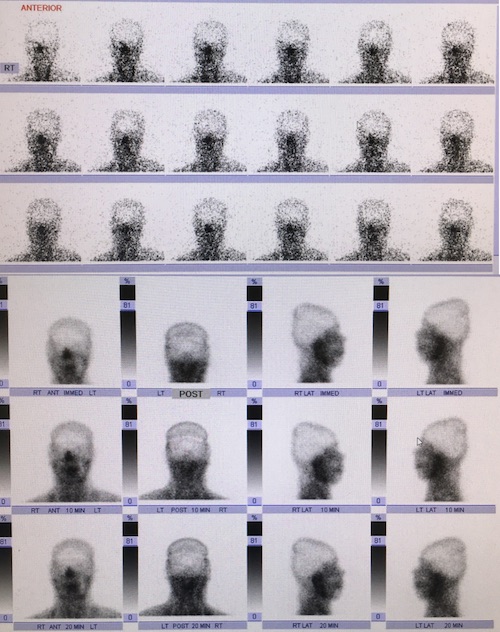
Brain Death by Nuclear Cerebral Scintigraphy
Cranial Nerve Reflexes
Pupillary Light Reflex
- Test: Light Shown into the Eye
- Normal Reflex: Prompts Pupil Constriction
- Absent Reflex: Pupil Does Not Constrict
Corneal Reflex
- Test: Cornea Touched with Cotton Swab or Saline
- Normal Reflex: Prompts Blinking
- Absent Reflex: Does Not Blink
Gag Reflex
- Test: Touching the Posterior Pharyngeal Wall
- Normal Reflex: Prompts Palate Elevation
- Absent Reflex: No Palate Elevation
Cough Reflex
- Test: Tracheal Suctioning
- Normal Reflex: Prompts Coughing
- Absent Reflex: Does Not Cough
Oculocephalic (Doll’s Eyes) Reflex (OCR)
- Test: With Eyes Held Open the Head is Briskly Turned Side-to-Side and Held at the End of the Turn
- Normal Reflex: Eyes Rotate to the Opposite Side of Head Rotation (Continue to Look Forward)
- Absent Reflex: Eyes Do Not Rotate
- *Must First Ensure that the Cervical Spine is Clear and May Be Unable to Perform if a Collar is in Place
Oculovestibular (Cold Caloric) Reflex (OVR)
- Test: With Head Elevated at 30 Degrees, 200 cc of Ice Water is Instilled into the External Ear Canal
- Normal Reflex: Nystagmus with Eye Deviation to the Tested Ear
- Absent Reflex: No Nystagmus Seen
Apnea Test
Test
- Preoxygenate with 100% O2 for at Least 10 Minutes Before Starting
- Ensure CO2 Normal (35-45 mmHg) by ABG Before Starting
- Disconnect the Ventilator for 10 Minutes
- Continue to Deliver O2 During the Test
- Monitor for Spontaneous Respirations During the Test
- Repeat an ABG After 10 Minutes
Positive Test Result (Requires All for Diagnosis of Brain Death)
- (1) No Respirations are Seen
- (2) Arterial pH < 7.30
- (3) PaCO2 ≥ 60 mmHg AND Increases by ≥ 20 mmHg
- If Known the Have Chronic CO2 Retention: Increase by ≥ 20 mmHg Above the Known Chronic Elevated Level
- *Previously “OR” Prior to 2023 Guidelines
- *Can Continue Testing Beyond 10 Minutes and Repeat ABG Every 2 Minutes if ABG Thresholds are Not Met
Indications to Abort Apnea Testing
- Hemodynamic Instability: SBP < 100 mmHg or MAP < 75 mmHg Despite Titration of Vasopressors, Inotropes, or Fluids
- Hypoxia: Progressive Decrease in SpO2 < 85%
- Cardiac Arrhythmia with Hemodynamic Instability