Bradycardia and Bradyarrhythmias
David Ray Velez, MD
Table of Contents
Classification
Bradycardia: Heart Rate < 60 Beats per Minute
Narrow Complex Bradycardia
- Regular Rhythm
- Sinus Bradycardia
- Third Degree (Complete) AV Block – with Junctional Escape
- Irregular Rhythm
- Atrial Fibrillation with Slowed Ventricular Response
- Second Degree AV Block, Type I (Wenkebach)
- Second Degree AV Block, Type II
Wide Complex Bradycardia
- Regular Rhythm
- Third Degree (Complete) AV Block – with Ventricular Escape
- Irregular Rhythm
- Second Degree AV Block, Type I (Wenkebach)
- Second Degree AV Block, Type II
EKG Patterns
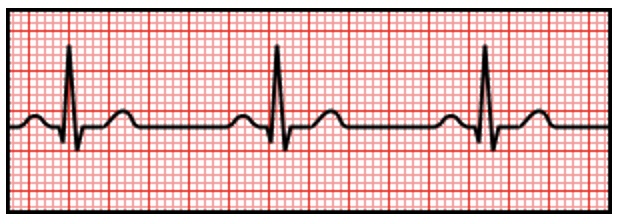
Sinus Bradycardia
- HR < 50-60 bpm
- Normal P Waves

Sinus Bradycardia
First Degree AV Block
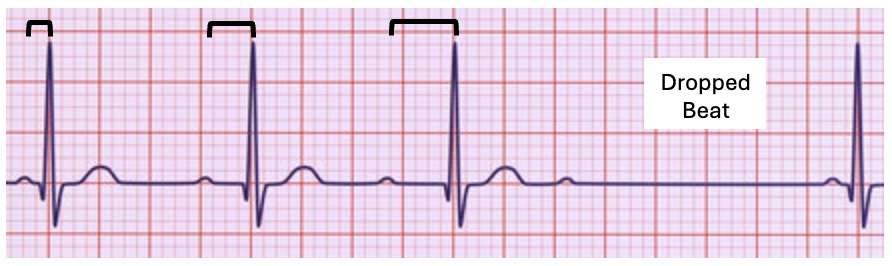
- Prolonged PR Interval > 200 ms
- No Interruption in AV Conduction

First Degree AV Block
Second Degree AV Block, Mobitz Type I (Wenkebach)
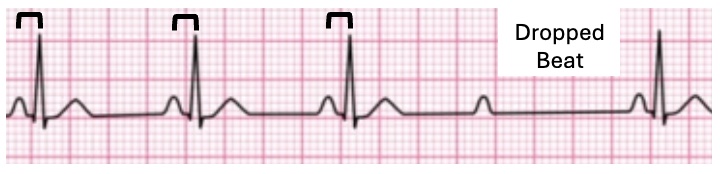
- Progressive PR Interval Prolongation Followed by Dropped Beats
- The Largest Absolute PR Interval Increase is Most Often Between the First and Second Beats of the Cycle
- The P-P Interval Remains Relatively Constant Throughout the Cycle
- The R-R Interval Progressively Decreases Throughout the Cycle
- Often Cycles in a Repeated P:QRS Ratio (3:2, etc.)

Second Degree AV Block, Mobitz Type I (Wenkebach)
Second Degree AV Block, Mobitz Type II
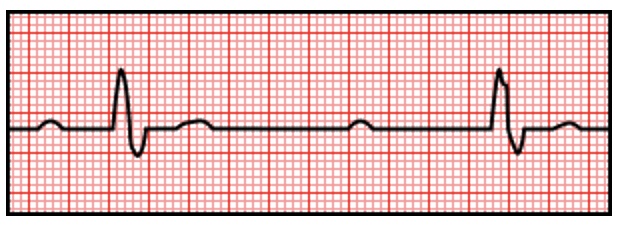
- Normal PR Interval (120-200 ms)
- Sudden Dropped Beats
- P Waves “March” Through at a Constant Rate

Second Degree AV Block, Mobitz Type II
Third Degree AV Block (Complete Heart Block)

- P Wave and QRS Complex are Completely Independent
- The P-P Interval Remains Relatively Constant

Third Degree AV Block
